
Preserving the stories behind family recipes
- My role
- UX Researcher & UX/UI Designer
- Timeline
- March–June 2026
- Work for
- DePaul University · Capstone project
- Team
- 4 MS in HCI students
- Tools
- Dovetail, Figma, Google Sheets
6 Research interviews
Cross-generational · ages 24–89
2 Usability testing rounds
8 participants in each round
6 Core tasks evaluated
From joining a cookbook to capturing a recipe and sharing a memory.
The challenge
Families preserve ingredients and instructions, but the stories behind recipes often remain unwritten. When that knowledge lives with one person, it becomes difficult to pass down.
The concept
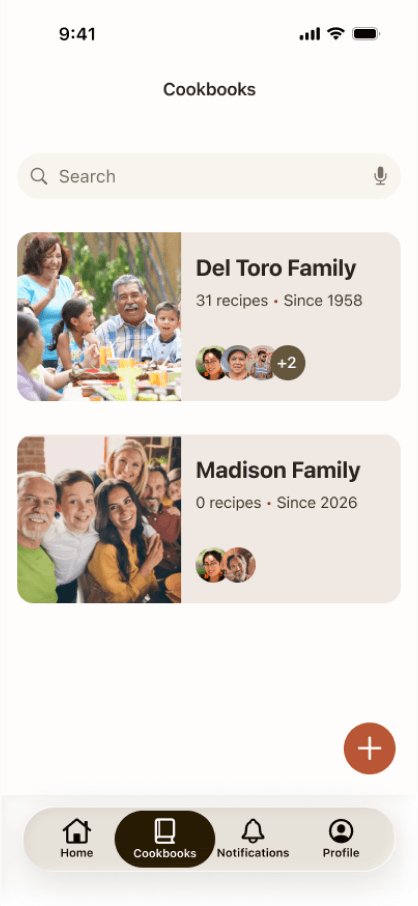
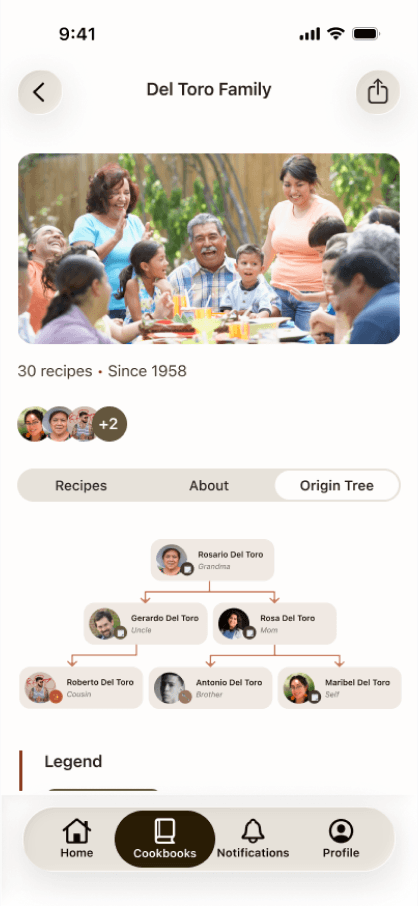
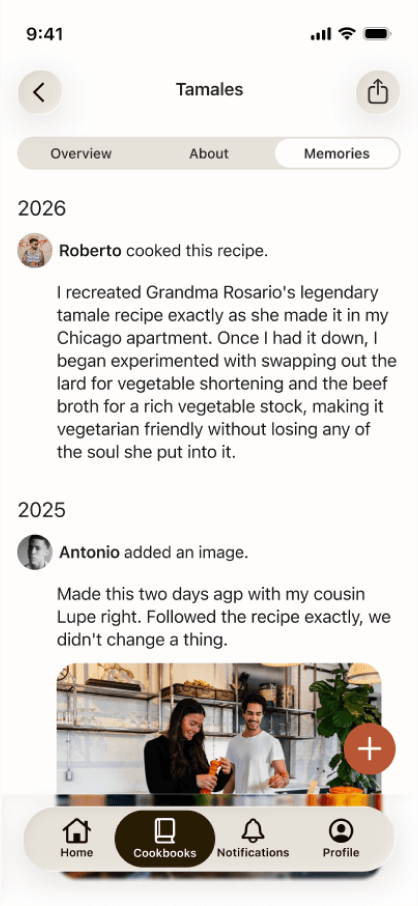
We created Taste of Home, a high-fidelity prototype for a native iOS app where family members can document recipes, connect them to their origins, add memories, and contribute to cookbooks together.
My contribution
Our four-person team shared work across research and design. I helped broaden recruitment across generations, recruited and interviewed a mother–daughter pair in Spanish, and interpreted Apple’s layout and grid guidance for our shared UI library.
Context & Process
A recipe is more than its ingredients.
A handwritten recipe might tell you how much flour to add without explaining who first made it, why it became a holiday tradition, or how relatives changed it. We explored how families preserve that knowledge alongside the recipe.
How might we help families preserve and share the stories, traditions, and memories behind their recipes across generations?
We followed the Double Diamond over ten weeks. Discover and Define helped us frame the opportunity; Develop and Deliver helped us design, evaluate, and refine the concept.
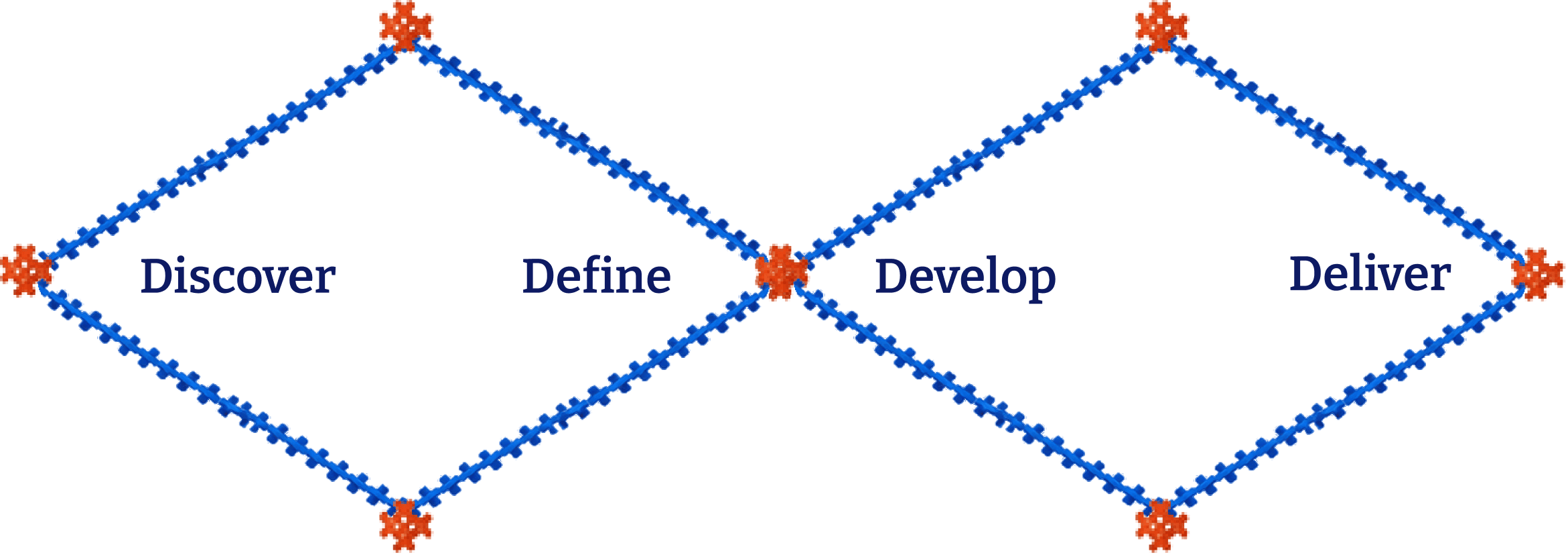
Discover
- Literature review
- Competitive analysis
- User interviews
Define
- Synthesis
- Personas & journey maps
Develop
- Crazy 8s
- IA & user flows
- Low- and mid-fidelity prototypes
Deliver
- Two testing rounds
- High-fidelity prototypes
- UI library
Three goals shaped what we designed and evaluated.
G1:Heritage visibility
Trace a recipe’s origin through a visual family tree and understand its cultural context without assistance.
G2:Story capture
Attach a personal story, memory, or note alongside a recipe. Original target: 1–3 minutes.
G3:Collaborative cookbooks
Invite family members to a shared cookbook, add recipes together, and keep each person’s contributions visible.
We prioritized mobile and tablet for kitchen use, with limited desktop coverage.
Discover
Understanding how family knowledge is kept and lost.
We began by exploring how families preserve recipes, stories, and cultural knowledge.
Grounding the opportunity
We reviewed three peer-reviewed sources on cultural food traditions, intergenerational knowledge, and family memory. They reinforced the need to preserve stories and cultural context alongside recipes, with shared participation across generations.
Preserving local food traditions
What it contributed
Shared participation across generations helps preserve cultural food traditions. Differences in values and digital engagement can interrupt that exchange.
How it influenced the design
G3 · Collaborative cookbooks, co-authorship, and input methods for different levels of technological comfort.
Reference
D’Andrea, A., & D’Ulizia, A. (2023). Preserving local food traditions: A hybrid participatory approach for stimulating transgenerational dialogue. Societies, 13(4), Article 95. https://doi.org/10.3390/soc13040095 (opens in a new tab)
Where existing tools stopped short
We reviewed Recipe Roots, Recipe Keeper, and Heirloom. None of the reviewed experiences combined heritage visibility, contributing to shared cookbooks, and showing how recipes change over time. This comparison helped sharpen our three design goals.
Recipe Roots was closest to our concept, with partial family-tree functionality. Heirloom focused on legacy documentation within a broader service. Our review helped us distinguish Taste of Home through heritage, stories, and shared contributions.
Feature comparison
| Feature | Taste of Home | Recipe Roots | Recipe Keeper | Heirloom |
|---|---|---|---|---|
| Family recipe tree / origin map | Yes | Partial | No | No |
| Visual recipe evolution over time | Yes | No | No | No |
| Scan and store handwritten recipes | Yes | No | Partial | No |
| Upload images and notes tied to recipes | Yes | No | No | Yes |
| Collaborative family cookbook | Yes | No | No | No |
| Share and export recipes | Yes | No | Yes | No |
| Public / private cookbooks | Yes | Partial | Yes | No |
The comparison covers lineage, recipe evolution, capture, memories, collaboration, sharing, and cookbook visibility.
Product positioning
| Characteristic | Taste of Home | Recipe Roots | Recipe Keeper | Heirloom |
|---|---|---|---|---|
| Product type | Standalone app | Standalone app | Standalone app | Feature within a broader service |
| Primary platform | iOS mobile-first | iOS & Android | iOS & Android | Web only |
| Product focus | Heritage & memory preservation | Recipe linking to family members | Recipe management | Legacy documentation |
| Target audience | People preserving cultural food traditions across generations | General home cooks | General home cooks | People planning legacy documentation |
| Collaboration model | Co-authorship | None | One-way sharing | None |
Based on our project-time competitive review. Taste of Home represents proposed capabilities, not a released product. Yes / Partial / No reflect the reviewed feature coverage.
Hearing how recipes travel through families
We conducted six remote, semi-structured interviews, recorded with consent.
How we recruited
- Word of mouth
- Personal & professional networks
Who we recruited
- Adults aged 18 or older
- Had cooked a family recipe
- Had tried to preserve, document, or share one
Six people. Two family connections.
Father & son, English
P2, 78, father; P1, 35, son
Family pair recruited by another teammate.
Mother & daughter, Spanish
P6, 89, mother; P5, 64, daughter
Recruited and interviewed in Spanish by me.
Individual participants, English
P3, 24, participant and P4, 24, participant, interviewed individually
Individual perspectives on family recipes.
Interview protocol
We guided each conversation through six topics, leaving room for participants to share their own experiences.
How do you see your family heritage passed down through the food you cook?
Define
From conversations to design direction
The interviews helped us see what families needed to keep alongside a recipe. We coded all six interviews in Dovetail, then used an in FigJam to find connections across people’s experiences.
6 Interview transcripts
Coded in Dovetail
12 Affinity clusters
Affinity diagram in FigJam
4 Recurring patterns
Shaped our feature directions
The findings
What we heard across the interviews
Recipes lived in different places
What we heard
Recipes, memories, and family history lived in different places, with no shared home connecting them.
What this meant for the design
- Bring recipes and their context into one shared collection.
- Support uploads from handwriting, photos, and existing apps.
- Organize recipes by meaningful categories, such as season or occasion.
Memories gave recipes meaning
What we heard
Recipes carried connections to people, occasions, and traditions.
What this meant for the design
- Keep memories, emotions, and cultural context alongside recipe instructions.
- Use conversational prompts or voice notes to support story capture.
- Support photos and short videos of cooking moments.
Knowledge often stayed unwritten
What we heard
Older relatives held knowledge learned through observation and practice, rather than written instructions.
What this meant for the design
- Reduce documentation effort with multiple input formats.
- Capture cooking techniques through photos and short videos.
- Support participation across different levels of digital confidence.
Sharing a recipe could leave its story and culture behind
What we heard
Sharing a recipe did not necessarily preserve its cultural background.
What this meant for the design
- Show recipe origins, generational background, and cultural significance.
- Preserve originals while allowing layered modifications and notes.
- Make family contributions visible, including who recreated a recipe.
Three people, one connected family experience
We refined our initial proto-personas after the interviews. Maribel, Antonio, and Rosario represent three connected family roles: preserving knowledge, adapting it, and passing it on. Their journey scenarios helped us define six core tasks for design and testing.
Maribel Del Toro
- Age: 35 | Gender: Female
- Location: Chicago, IL | Occupation: Marketing Manager
“I want to cook grandma's recipes exactly right and see how my brother makes them his own.”
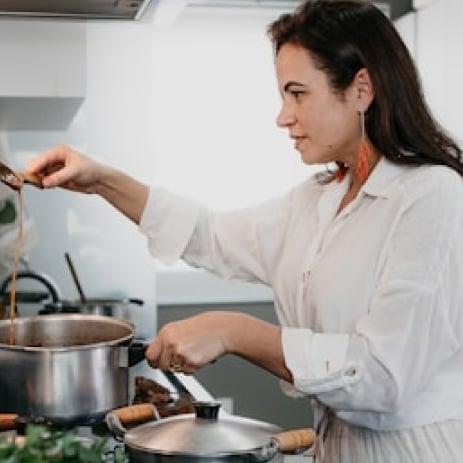
Bio
Maribel grew up watching her grandmother Rosario cook mostly from memory, with only a few written recipes. Now living in Chicago, she's the family's self-appointed keeper of culinary heritage, texting family members to confirm ingredient quantities and recreating dishes from half-remembered instructions.
She worries deeply that these recipes will disappear when they're not written down. With her younger brother Antonio experimenting in his own kitchen, she loves seeing his spin on classics but wants a way to see exactly what he changed.
Frustration
Fears that traditional recipes will be lost; grandma cooks from memory with no written record. Can't see how family members modify or personalize shared recipes, making it hard to trace the dish's evolution.
Goals
Preserve Rosario's recipes in a permanent digital home. Create a shared family cookbook that Antonio and other relatives can contribute to. Wants to clearly see who added or modified each recipe and what exactly changed.
Personality Traits
- Nostalgic
- Organized
- Family-oriented
- Detail-driven
Desires
- Preserve Family Legacy, 93%
- Transparency of Changes, 69%
- Family Collaboration, 76%
Preserve Rosario’s recipes in a shared family cookbook and track how relatives make them their own.

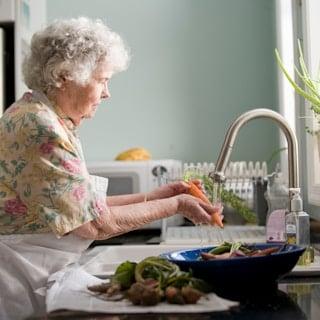
We brought the research findings and these family scenarios into four feature directions.
Recipe origins
Connect recipes to family members and cultural context.
Memories alongside recipes
Keep stories, photographs, and cooking moments with the recipe.
Flexible recipe capture
Use scanning and voice input to reduce documentation effort.
Shared family cookbooks
Bring recipes and family contributions into one shared collection.
These tasks gave us concrete situations to carry into the flows, prototypes, and usability studies.
T1: Create an account & join
Create a user account and join a family cookbook.
T2: Find the family history
Explore a cookbook’s origin and family history.
T3: Add a memory
Select a recipe and attach a note, image, video, or memory.
T4: Make it your own & share
Modify an existing recipe and share its link.
T5: Build a shared cookbook
Create a public cookbook and invite a relative.
T6: Capture a recipe
Add a recipe through photo scanning or voice-to-text.
Develop
From family stories to something we could test.
With the family’s needs in mind, we explored how recipes, memories, and shared contributions could come together in one experience.
Exploring different directions
We explored different directions through Crazy 8s, then turned our research and feature ideas into wireframes for onboarding, home, cookbooks, and recipes.
Making the cookbook the starting point
While designing the home screen, I noticed it repeated content already available in the cookbook and recipe views. I proposed making the cookbook the main home experience, with search and filters supporting recipe discovery.
Our teammates and studio reviewers also recognized the overlap. We decided to focus on cookbooks and leave a separate home screen for future research and testing.
“Cookbooks is the heart of the app.”
Looking beyond individual screens
Designing the profile made me think beyond the screen itself. How would the information someone entered help build the family tree and connect them to others in a cookbook? One question led to another and brought me to the invitation screen. My annotations helped us discuss where these connections should begin and how they would carry through the experience.
Where we landed
- Keep family invitations and permissions in cookbooks.
- Offer view-only sharing for individual recipes.
- Manage family relationships through the profile.
Bringing the six paths together
Each team member created happy paths for our core tasks. I combined them into one user flow and created a shared legend to keep our visual language consistent. Alongside the information architecture, it helped us review how screens and tasks connected across the app.
Making the experience testable
We brought the six core tasks into interactive mobile and tablet prototypes so participants could try the experience. These mid-fidelity prototypes became the starting point for our first usability testing round.
T1 : Create an account & join
T2 : Find the family history
T3 : Add a memory
T4 : Make it your own & share
T5 : Build a shared cookbook
T6 : Capture a recipe
Deliver
Learning from testing, then refining the experience.
We tested six tasks across two usability rounds with eight participants per round. Family history, memories, and recipe capture showed gains, while onboarding and editing still needed attention.
Round 1
8 participants · Ages 23–78
4 male · 4 female
Round 2
8 participants · Ages 24–78
7 male · 1 female
What we changed and why
Explore each task to connect the findings with our design decisions. The screens show the design stages; the metrics describe each testing round.
Find the family history
Where people struggled
Mid-fidelity screen
When looking for the cookbook’s family history, participants often opened a recipe and selected Recipe History. The cultural-origin description sat below the family tree, making the cookbook’s history harder to find.
Round 1 results
Success rate, intended path: 25%, 2 of 8
Mean time on task: 172 seconds, on a scale of 0 to 300 seconds
Guidance requests: 7 events, on a scale of 0 to 7
2 of 8 reached the task goal.
0 with recovery or help · 6 incomplete
What we changed
Round 2 prototype
We moved the cultural-origin description into the cookbook’s About section, alongside its family history, leaving Origin Tree focused on family relationships. We also clarified section labels and revised the task scenario.
Round 2 results
Success rate, intended path: 62.5%, 5 of 8
Mean time on task: 42 seconds, on a scale of 0 to 300 seconds
Guidance requests: 0 events, on a scale of 0 to 7
8 of 8 reached the task goal.
3 with recovery or help · 0 incomplete
What testing showed
Round 2 showed fewer requests for guidance. Because we also revised the scenario, the comparison reflects changes to both the design and the instructions.
Onboarding still needed attention. All eight participants initially missed the required profile-picture step. Six eventually joined the cookbook after recovery or help, while two stopped after creating an account.
Final prototype
A shared place to preserve, contribute, and revisit.
The final prototype brings family origins, recipe contributions, and shared memories into one connected experience.
Preserve family origins
Contribute a recipe
Revisit family memories
Design library
A shared design library with layout as my focus
We brought our colors, typography, layout guidance, and reusable components together to keep the mobile and tablet screens consistent.
Reflection
A project we connected with
One of my favorite parts of this project was working with a team that cared about the idea and could relate it to our own family experiences. Alongside research and design, we shared responsibility for prioritizing work, coordinating tasks, and keeping the project moving.
Hearing participants’ family memories gave meaning to what we were designing, while usability testing showed us where the experience needed more work.
What I would do differently
Test the information architecture
I would spend more time refining and testing the navigation and content organization, exploring how people expect recipes, cookbooks, memories, and family connections to fit together beyond individual task flows.
Observe shared family moments
I would conduct a field study in people’s kitchens, observing how families cook together, share stories, and pass down recipes and traditions. This could reveal how Taste of Home might support those moments, where it could interrupt them, and what our remote sessions missed.